Accelerating the Robot Dream
Empowering robot innovation, providing full-cycle development services, reducing costs, and accelerating the commercialization process.
Contact Us +


Henan Xspirebot
Xspirebot specializes in the design, production, and servicing of robot platform solutions.

Quality Control
A comprehensive quality control system that manages everything from raw materials to finished products.

Service & After sales
24-hour after-sales service. Please do not hesitate to contact us if you have any questions.

Download
XspireBot provide downloads of product catalogs, product solutions, and user manuals.

Key Member
Ten years of mass production experience and 32 patents in motion control.

Agricultural Industry
Agricultural robot chassis assists you in field operations such as sowing, spraying, and harvesting.

Manufacturing Industry
Industrial robot chassis assist you with tasks such as material handling, assembly, and quality inspection.

Transportation Industry
Autonomous transport robots that can deliver goods around the clock in urban and industrial environments.

Warehousing Industry
Unmanned transport robots enable full autonomy in cargo stacking & transfer within IoT logistics.

Inspection Industry
Autonomous 24/7 patrols at power facilities, industrial sites, data centers, and other locations.

Firefighting Industry
Autonomous fire detection & suppression in high-risk environments: high-rises, chemical plants, and data centers.
Four Wheel Drive Kit

Robot Chassis
Xspirebot offers chassis for indoor and outdoor mobile robots suitable for different terrains.

Motors
Drive motor designed for mobile robot chassis, applied to mobile robot platform & agricultural robot chassis.

Controller/Drive
The controller can control the robot chassis's movement, positioning, obstacle avoidance, path planning, and other motion functions.

Sensor
Xspirebot offers advanced sensors for autonomous robot platforms: cameras, ultrasonic radar, LiDAR, IMU, & IINS.

Electric Motor Axle
Xspirebot adapts electric transaxle load, power output, & layout to meet customer needs.

Wired Components
Line control braking & steering enhance vehicle control efficiency & precision via electronic signals.

Energy
Solar panels & batteries offer flexible solutions, letting you choose components to suit your needs.

Company News
Xspirebot is committed to helping our customers reduce development costs, shorten the R&D cycle, and accelerate the mass production process through platformized and modularized architectural design and standardized production processes.

Exhibition News
Xspirebot is committed to helping our customers reduce development costs, shorten the R&D cycle, and accelerate the mass production process through platformized and modularized architectural design and standardized production processes.

Industry News
Xspirebot is committed to helping our customers reduce development costs, shorten the R&D cycle, and accelerate the mass production process through platformized and modularized architectural design and standardized production processes.
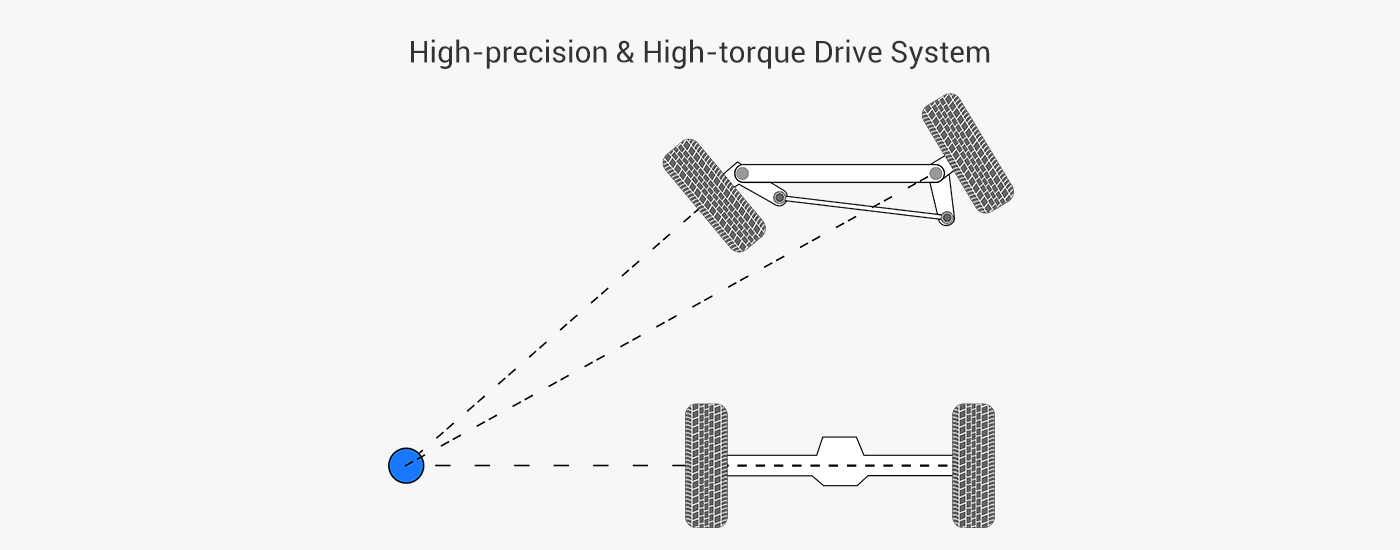
The high-precision 2WD Ackermann steering robot chassis with rear-wheel drive (RWD) is a common mobile robot platform design, frequently used in autonomous driving, logistics, security, agriculture, and mobility assistance applications. This chassis achieves power delivery through rear differential drive, while the front wheels employ Ackerman steering geometry for precise directional control. This ensures matching speed differences between inner and outer wheels during turns, preventing tire slippage and enhancing handling stability and path-tracking accuracy.

This high-precision, rear-wheel-drive (RWD) 2WD Ackermann steering robot chassis is a common mobile robot platform design widely used in autonomous driving, logistics, security, agriculture, and mobility assistance. This 2WD robot chassis transmits power via rear-wheel drive, while the front wheels utilize Ackermann steering to achieve precise directional control. When the vehicle turns, the steering angle of the inner front wheel is greater than that of the outer front wheel, causing the centers of the tracks of all wheels to converge approximately at a single point, thereby reducing tire slippage and wear.
Table parameters
| Design Dimensions | 1320mm*785mm*490mm | Gross Vehicle Weight | 125kg |
| Structural Configuration | Front-wheel steering, rear-wheel drive with Ackermann steering | Suspension Type | Solid axle suspension |
| Ground Clearance | 115mm | Wheelbase | 600mm |
| Wheelbase | 665mm | Tire Diameter | 420mm |
| Minimum Turning Radius | 1.7m | Battery | 48V/20AH (Standard) 48V/40AH (Optional) |
| Charging Time | ≤4h | Charging Method | 48V/5A charger Manual charging |
| External Power Supply | 48V/10A 24V/15A 12V/15A | Braking System | Motor brake |
| Parking Method | Electromagnetic brake | Vertical Load Capacity (Level Surface) | 100kg |
| Operating Speed | 8 km/h | Fording Depth | 80mm |
| Range | 45 km (unloaded)/30 km (loaded) (20Ah) | Maximum Gradeability | 20° (unloaded)/10° (loaded) |
| Crossing Width | 270 mm (unloaded)/200 mm (loaded) | Obstacle Clearance | 90mm (No Load)/60mm (Full Load) |
| Protection Rating | IP44 | Communication Method | CAN2.0B |
| Operating Temperature | / | Optional Equipment | APOLLO Open-Source Navigation Kit/Autoware Open-Source Navigation Kit/NV-auto Commercial Navigation Kit/Combined Inertial Navigation RTK/Automatic Charging Station/Robotic Arm/LiDAR/Depth Stereo Camera |
Precision services for professionals in the following scenarios:
Medium-to-high-speed motion scenarios:
- Automated logistics delivery (chassis for e-commerce delivery robots)
- Security patrols (chassis for high-speed patrol robots)
Complex outdoor/industrial environments:
- Mining/construction industry (construction machinery automation)
- Agricultural robotics (bird deterrence, irrigation, mowing, pesticide spraying)
Long-distance/high-intensity operations: e.g., warehouse logistics and transportation, energy inspection (power/pipeline inspection);
Comparison Items | Ackermann steering + rear-wheel drive | Four-wheel independent steering/omnidirectional wheels | Differential Steering | Precursor Ackerman |
| Steering Precision and Path Tracking | Extremely high (centimeter-level) | High | Average (Prone to drifting) | High |
| Minimum Turning Radius | Very small (achievable with wheelbase ≈ turning radius | Near zero (turns on the spot) | Significant | Low |
High-Speed Stability (>15 km/h) | Excellent (matches real vehicles) | Average (dangerous with high center of gravity) | Poor (Severe sideways skidding) | Average |
Energy Consumption and Range | Excellent (no steering friction loss) | Poor (all four steering motors constantly running) | Good | Average |
Load Capacit | Extremely strong | Weak (complex structure) | Average | Strong |
Off-Road Capability | Excellent (large wheel diameter + suspension damping) | Poor | Good | Average |
Parts Cost and Reliabilit | Low | High | Low | c |
Maintenance Difficulty | Extremely low | High | Low | Medium |
In robotic chassis—particularly AGVs, AMRs, and agricultural/inspection robots—the core advantage of Ackermann steering lies in its ability to reduce tire wear and extend tire life during turns. At the same time, it reduces steering resistance, making steering more agile and precise. Furthermore, the Ackermann steering geometry design not only enables centimeter-level trajectory tracking accuracy (especially during long-distance repetitive tasks) but also helps reduce body roll, improving vehicle stability—particularly during high-speed operation and in emergency situations.
When should this solution be abandoned?
When 360° turning in place is required (e.g., indoor narrow warehouses, hospitals, hotels, office buildings needing U-turns/sideways movement) → Choose four-wheel independent steering
Ultra-small educational/desktop robots (<30kg) operating only on flat indoor surfaces → Choose two-wheel differential + caster wheels
Ultra-low-cost educational kits → Also choose differential

However, for any outdoor, medium-to-large-scale, long-range, high-precision robots that may eventually operate on public roads, we strongly recommend the 2WD Ackermann steering robot chassis.
Related Accessories
Accelerating the Robot Dream
Empowering robot innovation, providing full-cycle development services, reducing costs, and accelerating the commercialization process.
Contact Us +