Accelerating the Robot Dream
Empowering robot innovation, providing full-cycle development services, reducing costs, and accelerating the commercialization process.
Contact Us +


Henan Xspirebot
Xspirebot specializes in the design, production, and servicing of robot platform solutions.

Quality Control
A comprehensive quality control system that manages everything from raw materials to finished products.

Service & After sales
24-hour after-sales service. Please do not hesitate to contact us if you have any questions.

Download
XspireBot provide downloads of product catalogs, product solutions, and user manuals.

Key Member
Ten years of mass production experience and 32 patents in motion control.

Agricultural Industry
Agricultural robot chassis assists you in field operations such as sowing, spraying, and harvesting.

Manufacturing Industry
Industrial robot chassis assist you with tasks such as material handling, assembly, and quality inspection.

Transportation Industry
Autonomous transport robots that can deliver goods around the clock in urban and industrial environments.

Warehousing Industry
Unmanned transport robots enable full autonomy in cargo stacking & transfer within IoT logistics.

Inspection Industry
Autonomous 24/7 patrols at power facilities, industrial sites, data centers, and other locations.

Firefighting Industry
Autonomous fire detection & suppression in high-risk environments: high-rises, chemical plants, and data centers.
Four Wheel Drive Kit

Robot Chassis
Xspirebot offers chassis for indoor and outdoor mobile robots suitable for different terrains.

Motors
Drive motor designed for mobile robot chassis, applied to mobile robot platform & agricultural robot chassis.

Controller/Drive
The controller can control the robot chassis's movement, positioning, obstacle avoidance, path planning, and other motion functions.

Sensor
Xspirebot offers advanced sensors for autonomous robot platforms: cameras, ultrasonic radar, LiDAR, IMU, & IINS.

Electric Motor Axle
Xspirebot adapts electric transaxle load, power output, & layout to meet customer needs.

Wired Components
Line control braking & steering enhance vehicle control efficiency & precision via electronic signals.

Energy
Solar panels & batteries offer flexible solutions, letting you choose components to suit your needs.

Company News
Xspirebot is committed to helping our customers reduce development costs, shorten the R&D cycle, and accelerate the mass production process through platformized and modularized architectural design and standardized production processes.

Exhibition News
Xspirebot is committed to helping our customers reduce development costs, shorten the R&D cycle, and accelerate the mass production process through platformized and modularized architectural design and standardized production processes.

Industry News
Xspirebot is committed to helping our customers reduce development costs, shorten the R&D cycle, and accelerate the mass production process through platformized and modularized architectural design and standardized production processes.
With the continuous advancement of industrial automation and smart logistics, logistics robots are gradually evolving toward greater automation and integration. Moving from traditional magnetic strip navigation to today’s trackless autonomous navigation, they are now capable of providing comprehensive automation solutions for warehouses, factories, and logistics centers.
Compared to traditional magnetic strip or QR code navigation, LiDAR navigation does not require the pre-installation of magnetic strip tracks or QR codes. It can not only create maps autonomously but also adapt to real-time obstacle avoidance needs, making it particularly suitable for scenarios where pre-installation of markers is difficult, such as greenhouses, pipeline inspections, and warehouse logistics.

Magnetic strip navigation involves laying magnetic strips along a predefined path, with the robot’s chassis identifying the path via magnetic sensors. Although the cost is lower, the path becomes fixed once the magnetic strips are laid, requiring reinstallation every time the route is adjusted; if the strips become worn, positioning may drift, affecting transportation.
QR code navigation involves affixing a matrix of QR codes to the ground, with the AGV using a camera to identify its position. Compared to magnetic strip navigation, route adjustments are more flexible, requiring only the reapplication of codes. However, the QR codes require regular maintenance to ensure they remain clean; in a workshop environment, QR code labels are easily worn down, which can affect transportation operations.
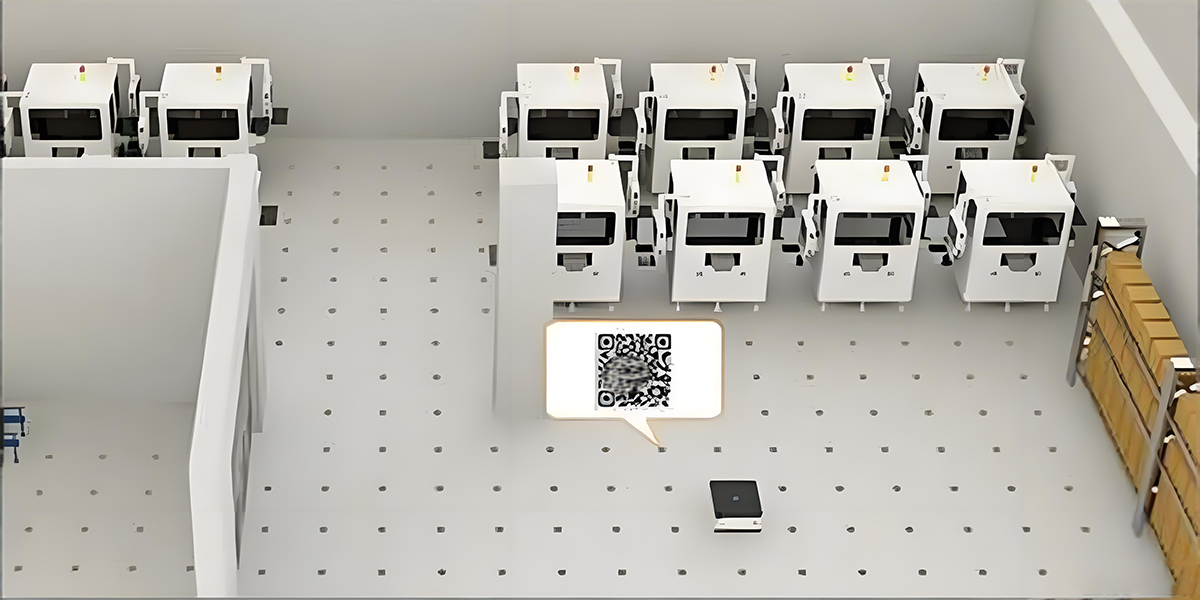
Why Choose Trackless Autonomous Navigation?
Traditional mobile robots rely heavily on magnetic strips or inertial sensors, with these systems navigating via paths or embedded magnetic tracks on the ground. In contrast, trackless autonomous navigation utilizes advanced sensors and algorithms to achieve real-time environmental perception and path planning. The robot can autonomously detect obstacles, calculate new routes, and respond within milliseconds using LiDAR, visual cameras, and SLAM (Simultaneous Localization and Mapping) technology.
Our company specializes in the R&D of robot chassis and accessories and has designed multiple robot chassis that support line-free navigation. These solutions are compatible with mainstream algorithm frameworks and feature optimized sensor integration, helping you transition from magnetic strip systems to autonomous mode.
Modular Design: The chassis supports quick replacement of sensor modules to adapt to different scenarios, such as warehousing or manufacturing.
Highly Rugged and Durable: Components undergo rigorous testing and meet the IP67 protection rating standard (customizable based on customer requirements), ensuring stable operation in dusty or humid environments.
Open, Standardized Interfaces: The chassis comes pre-equipped with multiple CAN/RS485/Ethernet communication interfaces and 24V/48V power outputs, supporting plug-and-play functionality. It is compatible with core SLAM devices such as LiDAR, depth cameras, and industrial PCs.
Accelerating the Robot Dream
Empowering robot innovation, providing full-cycle development services, reducing costs, and accelerating the commercialization process.
Contact Us +